
Posts for Resistance at Gallery Manifesto
Monday 01 June 2026 12:00 / Exhibition Opening
Saturday 06 June 19:30 Panel Discussion + Exhibition Closing
What if gallery walls replaced social media feeds? What if our posts became artworks of resistance?
We welcome you to Posts for Resistance, a collaborative action by Sarajevo Photography Festival, Gallery Manifesto, Peter Watkins and Michele Faguet, inspired by Postcards for Palestine — a project where small works become acts of solidarity, memory and collective voice.
Social media platforms have become dominant arenas for advocacy—today, to resist and to protest often means to post. Yet these posts quickly disappear into algorithmic voids, reduced to digital noise, or are censored altogether. The question remains: how do we express resistance beyond the internet?
We invite you to bring a work on paper to Gallery Manifesto from June 1 to June 6, between 12:00 and 20:00, place it on the gallery wall, and take part in a collective act of resistance through art.
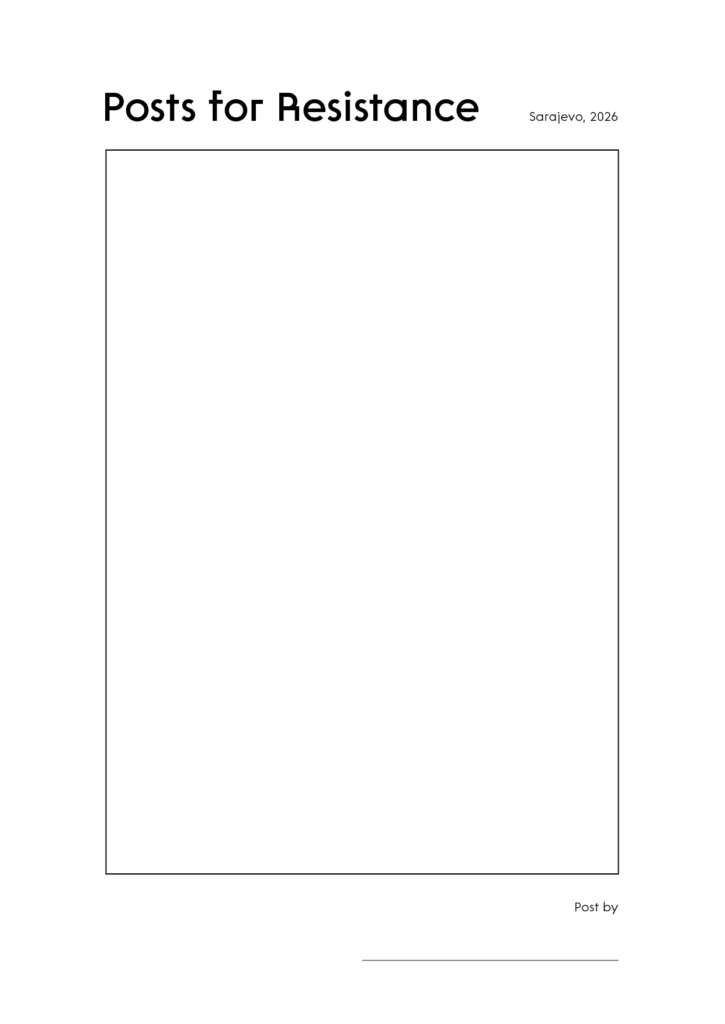 Your work should be:
- Photograph, drawing, text, poem, or work in any other medium
- A5 format only (148 × 210 mm)
- Addressing resistance to discrimination, injustice, war, violence, individual or shared experiences of grief
- Without a physical frame; just the piece.
You can download the template on which the A5 will be pasted here.
This open call is for everyone. Materials will be available on site if you wish to produce something in the space. The emphasis is on voice, presence, and collective expression. Contributions can be made until Saturday 6 June at 19:00 at which point a panel discussion will be held at Gallery Manifesto as the closing event of the Sarajevo Photography Festival.
This exhibition forms part of a wider presentation including Postcards for Palestine , alongside works by a group of photographers and filmmakers from Gaza:
• Feda Hassanat/ @feda.hassanat,
• Bisan Nateel / @bisannateel
• Mohammed Moharm / @mohammedmoharm
• Mohammed Nateel / @mohnateel
•Mohamed Zediah / @mozediah
• Moayed Abu Ammouna / @moayed.abuammouna
• Abd Nabahin / @abd_nabahin
Peter Watkins is an artist and educator based in Prague, Czech Republic. His practice examines familial loss, trauma, and memory through an archival and materially oriented practice, with recent work addressing state power, erasure, and political marginalisation.
His projects have been exhibited internationally, including The Unforgetting, Mother Tongue and Unearthing (Lidice) V1. He is the founder of Postcards for Palestine and lectures in photography at FAMU. His work is held in major collections including the Victoria and Albert Museum and Museum Winterthur.
Michele Faguet is a Berlin-based writer whose essays have examined documentary filmmaking, representational ethics, and participatory practice from a decolonial perspective. Her criticism and curatorial work are rooted in a sustained engagement with artists from the Global South, particularly Latin America. She has directed nonprofit spaces in Vancouver, Bogotá, and Mexico City and taught at the Universidad de los Andes (Bogotá) and the Dutch Art Institute.
Moayed Abu Ammouna works across filmmaking, photography, and experimental visual narrative to examine questions of land and indigeneity, the ruptures inflicted by colonialism and displacement, and the liminal condition of existence under genocide. Reflecting on—and challenging—the historical and lived conditions that define his generation and those born in the aftermath of the Nakba, Abu Ammouna considers how collective memory functions both as a site of mourning and a framework for imagining and shaping possible futures.
Feda Hassanat is a dynamic and passionate visual storyteller and field coordinator with experience across humanitarian work and media documentation, bridging art with activism to empower communities and raise voices from the margins.
Mohammed Moharm developed his photographic practice almost by chance, while taking long walks across the Gaza Strip, where he chronicled daily life before and during the genocide with his cherished secondhand Fujifilm X-E1 camera—a rarity in Gaza—given to him by a photojournalist friend. His powerfully evocative photographs document the reduction of a once thriving seaside landscape to rubble, while also bearing witness to ordinary moments of joy, resilience, and solidarity that have endured despite the devastation.
Abd Nabahin is a visual storyteller and multidisciplinary artist whose practice emerged from living through war and displacement, where documenting everyday life became both a necessity and a form of resistance—a space for reflection and witnessing. Through photography, visual archiving, and mixed-media practices, he explores the emotional weight of ordinary experiences—both individual and collective—under extreme circumstances.
Bisan Nateel moves between creative writing and photography to explore life in Gaza under conditions of war, displacement, and uncertainty. Through image-making she aspires to build a visual archive that amplifies marginalized voices and experiences that might otherwise remain unseen. In addition to her artistic practice, Nateel has led youth groups at Tamer Institute for Community Education, creating spaces where children and young people can express themselves through storytelling, drawing, and creative activities.
Mohammed Nateel is a documentary photographer whose humanitarian work for UNICEF has sought to preserve memory, raise awareness, and connect the global community to the realities on the ground faced by Palestinians. Through his lens, he chronicled the texture of ordinary life amid the destruction of Gaza, capturing untold stories of endurance and hope. His photographs in London contend with the weight of those memories and the encounter between vastly different worlds.
Mohamed Zediah is a photographer and filmmaker whose work has documented life under occupation and siege, centering the personal stories of Gazans, whose lives are too often reduced to headlines of victimhood and despair. For Zediah, filmmaking is an act of defiance—against geographical borders as well as the narrow parameters that constrain narratives shaped by war and exile. He was recently shortlisted for the Dior Photography and Visual Arts Award for Young Talents for his short film The First Time and the Last (2026).
Mohammed Moharm, Mohammed Nateel, and Mohamed Zediah live in London, where they are students in the MA Photography program at the Royal College of Art.
Abd Nabahin lives in Cornwall (UK) and is currently on the BA (Hons) Photography course at Falmouth University.
Moayed Abu Ammouna and Bisan Nateel have been accepted to the MRes Visual Cultures program at Goldsmiths, University of London. Feda Hassanat has received an offer to join the MFA Communication course at the Royal College of Art.
All three will begin their studies in September 2026 but require governmental evacuation assistance, as do many other students in Gaza who have been accepted to British universities with scholarships. If you are a UK resident, please consider writing to your member of parliament showing your support for UK evacuation assistance for Gaza students with scholarships in the UK.
Postcards for Palestine
Postcards for Palestine was an artist-run project initiated in October 2023 in response to Israel’s genocidal campaign in Gaza and the West Bank. It consisted of 1,322 original postcard-sized artworks contributed by artists from more than 40 countries, including established, emerging, and non-professional practitioners.
The project functioned both as a fundraising initiative and as a platform for collective visibility, international solidarity, and dialogue. Fundraising exhibitions were held at Berlinskej Model (Prague) and Claire de Rouen Books (London) in December 2023.
In 2024, Postcards for Palestine partnered with Arts of the Working Class (Berlin) to bring the project to the 60th edition of La Biennale di Venezia, where the remaining original postcards were distributed in collaboration with Artists + Allies x Hebron, as part of the exhibition South West Bank: Landworks, Collective Action and Sound.
Proceeds were donated to PCRF, UNRWA, Medical Aid for Palestinians, and Médecins Sans Frontières. Postcards for Palestine was founded by Peter Watkins.
Support for Palestinian Students to Study Abroad (SPSSA)
All higher education institutions in Gaza lie in ruins.
SPSSA is a volunteer initiative that has responded to this acute educational crisis by securing admissions offers and scholarships for seven talented photographers and filmmakers to safely evacuate from Gaza and continue their studies in the UK.
Our work has been made possible thanks to our collaborators—MACK Books, Gaza40+, and Gaza Scholarship Initiative (GSI)—as well as the numerous individuals who have contributed to our fundraiser and provided pastoral care to support these students.
https://chuffed.org/project/152090-support-for-palestinian-students-to-study-abroad-spssa